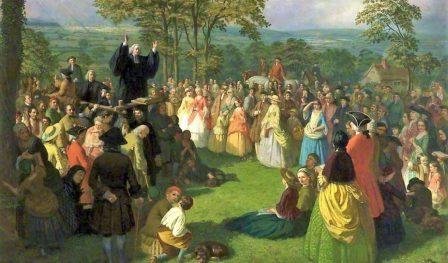
The Great Awakening viewed through the preaching of whitefield!
George Whitefield (/ˈwɪtfiːld/; 27 December [O.S. 16 December] 1714 – 30 September 1770), also spelled Whitfield, was an English Anglican cleric and evangelist who was one of the founders of Methodism and the evangelical movement.
Born in Gloucester, he matriculated at Pembroke College at the University of Oxford in 1732. There he joined the “Holy Club” and was introduced to the Wesley brothers, John and Charles, with whom he would work closely in his later ministry. Whitefield was ordained after receiving his Bachelor of Arts degree. He immediately began preaching, but he did not settle as the minister of any parish. Rather he became an itinerant preacher and evangelist. In 1740, Whitefield traveled to North America, where he preached a series of revivals that became part of the “Great Awakening“. His methods were controversial and he engaged in numerous debates and disputes with other clergymen.
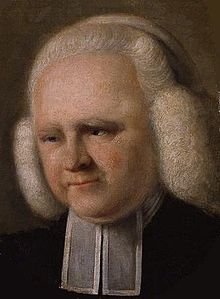
(Material courtesy Wikipedia) Whitefield received widespread recognition during his ministry; he preached at least 18,000 times to perhaps 10 million listeners in Great Britain and the American colonies. Whitefield could enthrall large audiences through a potent combination of drama, religious rhetoric, and imperial pride
In 1740, Whitefield traveled to North America, where he preached a series of revivals that became part of the “Great Awakening“. His methods were controversial and he engaged in numerous debates and disputes with other clergymen.
Early life
Whitefield was born on 27 December [O.S. 16 December] 1714 at the Bell Inn, Southgate Street, Gloucester in England. Whitefield was the fifth son (seventh and last child) of Thomas Whitefield and Elizabeth Edwards, who kept an inn at Gloucester. At an early age, he found that he had a passion and talent for acting in the theatre, a passion that he would carry on with the very theatrical re-enactments of Bible stories he told during his sermons. He was educated at The Crypt School, Gloucester, and Pembroke College, Oxford.
Because business at the inn had diminished, Whitefield did not have the means to pay for his tuition. He therefore came up to the University of Oxford as a servitor, the lowest rank of undergraduates. Granted free tuition, he acted as a servant to Fellows and Fellow-commoners; duties including teaching them in the morning, helping them bathe, cleaning their rooms, carrying their books, and assisting them with work. He was a part of the “Holy Club” at the University with the Wesley brothers, John and Charles. An illness, as well as Henry Scougal’s The Life of God in the Soul of Man, influenced him to turn to the Church. Following a religious conversion, he became passionate for preaching his new-found faith. The Bishop of Gloucester ordained him a deacon.